WordPress vs coded website: what should you choose?
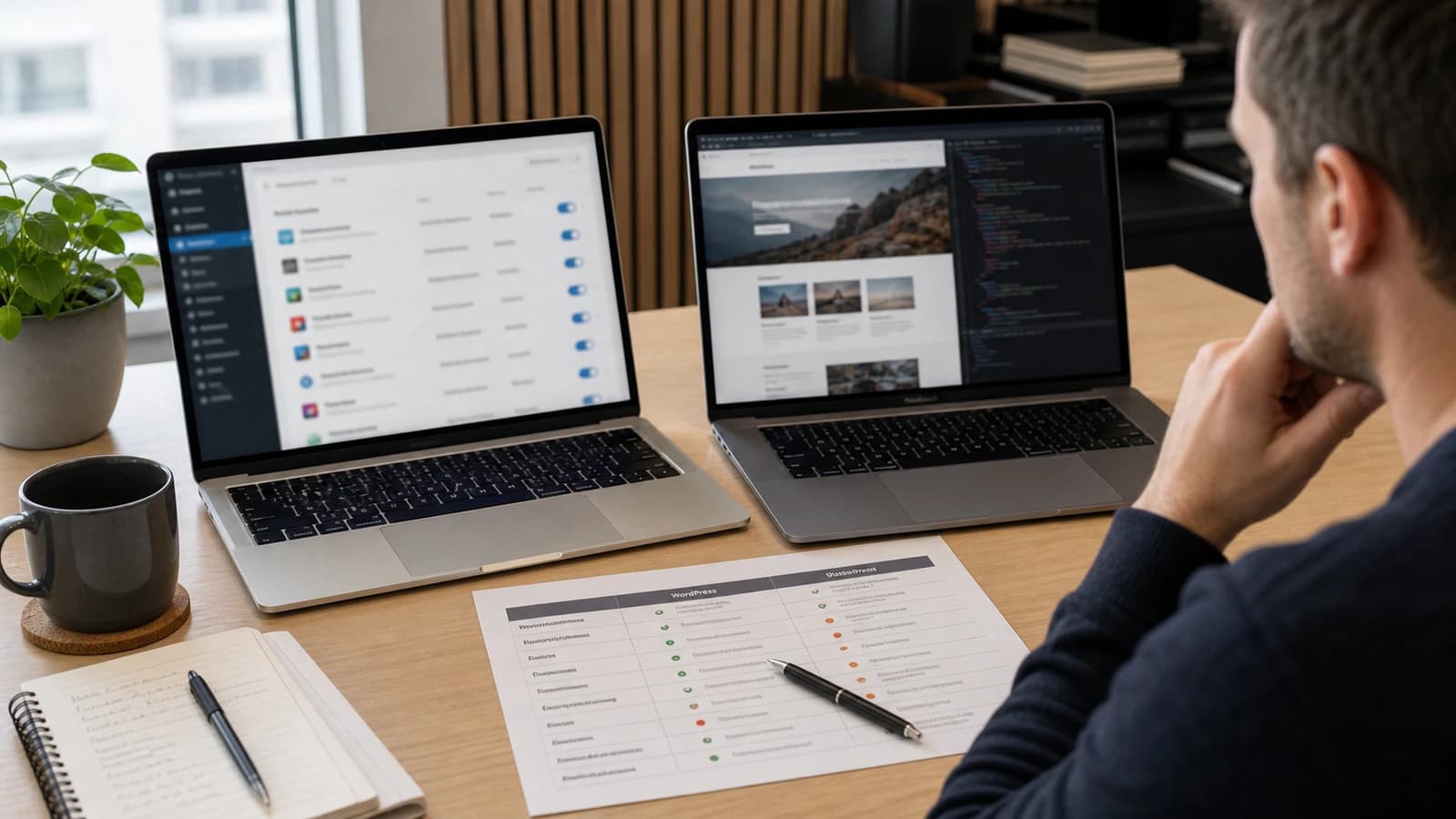
WordPress vs coded website is not about which camp is right. WordPress fits when content editing and ready-made extensions matter most. A coded website fits when speed, control, bespoke design, fewer dependencies and stable operation matter most.
There are bad WordPress sites and bad coded sites. The tool does not rescue weak work. The right question is what the business actually needs over the next few years. Will many employees publish content every week? Should the site be a lightning-fast presentation page with few changes? Do you need integrations, forms and special flows? The choice should follow the use.
At wevo, I usually build coded websites for businesses, because I like the control, speed and freedom. But I also say plainly when WordPress is right. An honest technical assessment is worth more than forcing everyone into the same tool.
What is WordPress?
WordPress is a publishing system, a CMS, that lets users create pages, posts and content through an administration panel. It has a huge ecosystem of themes and plugins. That makes WordPress flexible, especially for content-heavy websites. At the same time, the ecosystem means quality depends heavily on choices: theme, plugins, hosting, updates and who sets it up.
If Kari runs an organisation with many news items, several editors and a need for easy publishing, WordPress can be right. If Marius runs a specialised consulting firm with five important pages, a contact form and a need for extreme speed, a coded website may be better. Both can be professional. The mistake is choosing before the need is understood.
WordPress is also strong when the organisation already has people who can work in the system. Training is shorter, and content work can happen without a developer for every small change. But that freedom requires discipline. Too many plugins, too many editors and too little maintenance quickly turn the advantage into mess.
What is a coded website?
A coded website is built directly with modern web technology, often without a heavy standard theme or a large plugin layer. Content, design, components and integrations are built in a more controlled way. That can provide high speed, security, design freedom and less technical noise. The downside is that editing and new features must be planned more clearly.
For a smaller business, this can be an advantage. When the site has few important pages and clear goals, it does not need a large administration system. It needs precise content, good mobile experience, fast images and a form that works. Then it is often more efficient to build light than to start with a large CMS.
| Need | WordPress | Coded website |
|---|---|---|
| Many editors | Strong choice. | Requires its own editing setup. |
| Maximum speed | Possible, but requires discipline. | Often easier to keep light. |
| Unique design | Can be built, but theme may limit. | Full control from the start. |
| Plugins | Large selection. | Build only what is needed. |
| Maintenance | Plugins and updates must be followed closely. | Fewer parts, but code must be owned and operated. |

When should you choose WordPress?
Choose WordPress when content publishing is the main job. If the business will publish often, have several editors, use standard functions and wants a familiar administration panel, WordPress is strong. It is also a good choice when the customer already knows WordPress and has a routine for maintenance.
- You publish many articles, news items or landing pages.
- Several people will edit content without a developer.
- You need ready-made modules that already exist well in WordPress.
- You have someone who can follow up updates, security and backup.
- Design requirements are important, but not completely special.
When should you choose a coded website?
Choose a coded website when the site should be fast, bespoke and stable, and when content is not changed by many people all the time. For many small and medium businesses, the website is not a newspaper. It is a sales machine with clear services, good projects, forms and maybe a few integrations. Then a light coded solution can provide more control.
- You want bespoke design without theme dependency.
- You want high performance and good Core Web Vitals.
- You want fewer plugins and less technical noise.
- You need special forms, API integration or custom components.
- You want to own the structure and develop calmly over time.

What does the choice mean for security and operations?
WordPress is safe when operated correctly, but it often has more moving parts: core, theme, plugins, users and hosting. Each part must be updated. A coded website can have fewer entrances, but is not automatically safe. It still has to be built correctly, have secure forms, good dependencies and tidy deployment.
Operations are often the forgotten question. Who updates? Who takes backup? Who checks that forms work? Who cleans up when a plugin fails? This connects with website maintenance. A website is not finished because it is published. It must be kept healthy.
A tidy WordPress site can be a good choice for many years. A messy coded site can be a problem from day one. That is why the assessment is not about the name, but responsibility. Who owns the solution, who can change it, and who makes sure it still works?
How does wevo assess a WordPress alternative?
When I assess a WordPress alternative, I look at who will work with the site afterwards. If the owner wants to change everything every week, editing must be easy. If the owner would rather have a fast, beautiful and stable site that rarely changes, code is often better. If the need is in the middle, a headless CMS or a simple editing layer can be used.
A professional website vs template is also about this. Templates and plugins can give speed at the start, but can lock design and structure. Code takes more craft, but can give a site that fits the business precisely. For websites for businesses, I choose the direction that creates the least friction after launch.
Is WordPress better than a coded website?
Not always. WordPress is often best for content-heavy sites with many editors. A coded website is often better when speed, control and a bespoke experience matter most.
Is a coded website faster than WordPress?
It can be, because it often has fewer plugins and less JavaScript. But a badly coded site can also be slow. The quality of the work decides.
Can I edit a coded website myself?
Yes, if an editing layer or CMS is built in. If content rarely changes, it can also be better that changes are made in a controlled way by a developer.
What is a WordPress alternative?
A WordPress alternative can be a coded website, a lighter CMS, a headless CMS or a custom solution that fits design, performance and integrations better.
Want help with this? See how we work with websites.
Not sure where your website stands?
Run a free analysis and get an honest picture of speed, structure and things that could be stopping your customers.