CRM system: buy off the shelf or build your own?

A CRM system is where the customer relationships live: who the customers are, what has been said, where each of them is in the process, and who has the next step. Not the inbox, not a spreadsheet, and not the memory of whoever has been in the company longest.
The question I get is almost always the same: should we buy a CRM system or have one built? My answer surprises some people, because most of the time it is buy. Off-the-shelf is cheaper than anything I can code for you, and there are plenty of good products on the market.
But not always. Here I go through how I separate the two cases, what actually costs time, and what I look for before I recommend a bespoke system instead of a licence.
What a CRM system does in practice
CRM stands for customer relationship management, but the phrase helps nobody. In practice a CRM system does four things: it gathers the contacts, it remembers the history, it shows where each customer is in the process, and it reminds someone of the next step.
Everything else, meaning reports, email templates, quote templates, automation and dashboards, is built on top of those four. If what you really need is a tidy contact list with a bit of history, you do not need a CRM system. You need one place to write things down, and everyone using it.
When an off-the-shelf CRM system is the right call
For most small and medium businesses, off-the-shelf is the sensible choice. You get a mature product, updates without paying for the development, and an app that already works on the phone in the car.
- Your sales process looks like most: enquiry, quote, follow up, signed
- You are few enough that training takes an afternoon
- You need standard features, not rules nobody else has
- The budget covers a licence per user, but not a build project
If all four sound familiar, I say it plainly in the meeting: buy. Then we spend the money connecting the system to the website, the invoicing and the rest instead, so nobody enters the same detail twice.

When the spreadsheet beside it tells the truth
The clearest sign that a CRM system does not fit is not that people complain. It is that a spreadsheet has appeared beside it. Someone made it because the system could not hold the one detail the job actually revolves around.
- The price depends on something the system has no field for, so it is worked out in Excel
- The same customer exists in three places, and none of the versions is entirely wrong
- The statuses in the system are not the steps you actually have, so everyone uses their own
- Someone types the same thing into two systems every week and has stopped mentioning it
Even so, this is not automatically an argument for building. Sometimes the answer is a different off-the-shelf system, and often it is an integration that fills the gap. But when the list of detours gets long enough, the licence costs more in time than it saves.
What a bespoke CRM system costs in time
The money depends on scope, and you get a concrete, no-obligation quote before anything is built. Time is easier to describe, and it is where people underestimate the work.
- Mapping: we write down the sales process as it actually is, not as it should have been. You have to take part in this one.
- Data model: what is a customer, what is a case, and what should be able to sit in two places at once without confusing anyone.
- Building and integrations: the system itself, plus the connections to what you already use.
- Moving the old data: almost always more work than people expect, because old data is messy.
- Training and adjustment: the first weeks always reveal something, and there has to be room for that.
When I say no to building, it is usually step one that decides it: the process turns out to be entirely ordinary. It already exists, and there is no reason to pay to have it made again.
The CRM system has to talk to the rest
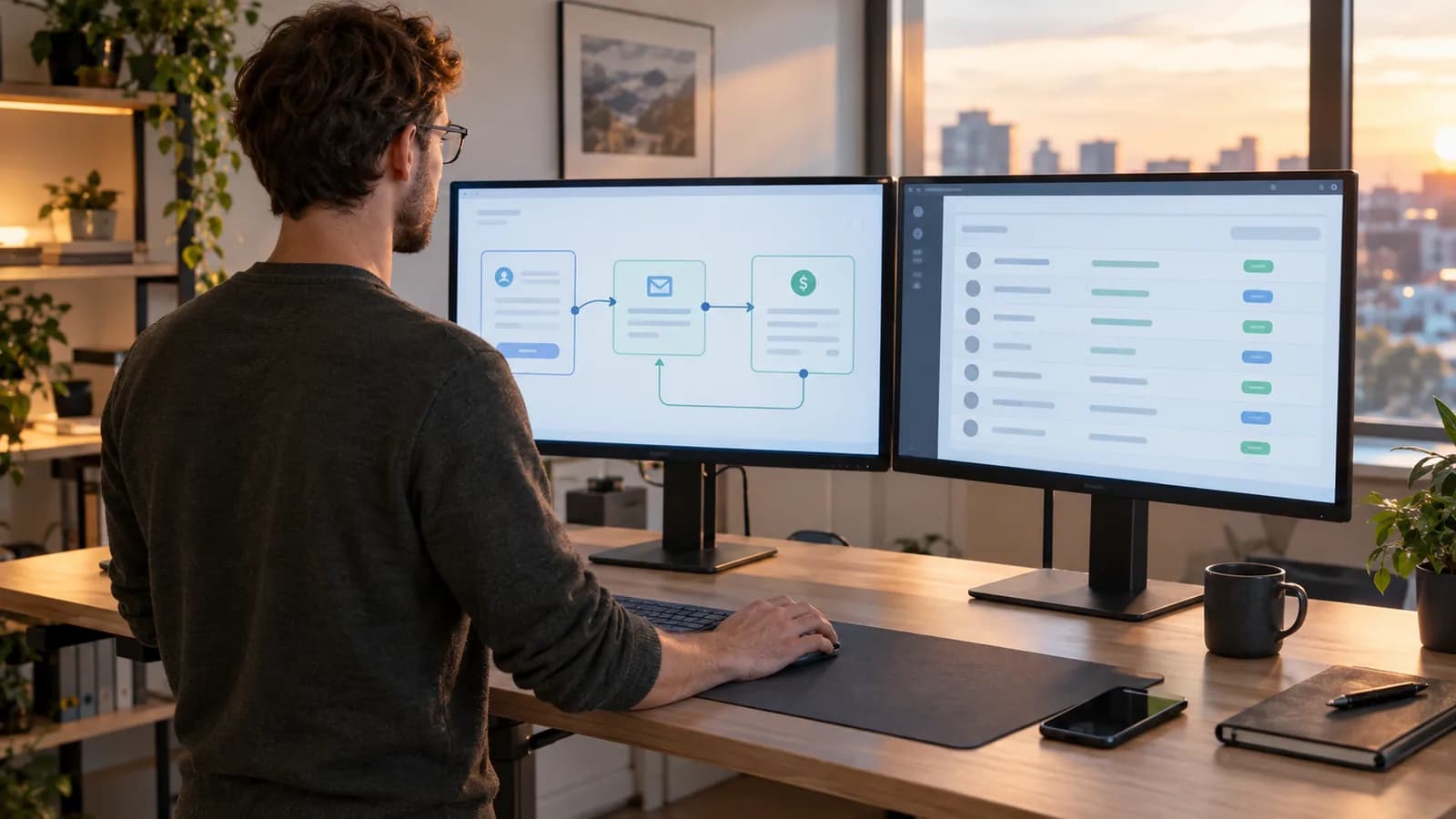
A CRM system standing on its own just becomes another place to type. The value arrives when it connects to the form on the website, the email, the invoicing and the line-of-business system you cannot replace.
That holds whichever way you go. We connect both off-the-shelf and bespoke solutions to the rest, and that is often where the biggest gain is. An enquiry from the website landing straight in the CRM system with the right source is a job nobody has to do by hand again.
How I choose together with the client
- Describe the process in five steps. If you manage it with no exceptions, off-the-shelf is enough.
- Count the exceptions. If there is one, live with it. If there are five, they become five spreadsheets.
- Find the detail that decides the price. If the system can hold it, much is solved.
- Ask who owns the data, and how you get it out again if you switch.
- Pick the smallest thing that solves the problem now. The rest can be built when you know more.
A CRM system is worth the money the moment nobody has to wonder what happens next with a customer. Whether that becomes a licence, a bespoke system or a combination depends on how many exceptions your process has. Describe the process in a couple of sentences and you get an honest answer from me, including when the answer is that you do not need me. If it is to be built, a CRM system belongs in the requirements for bespoke systems.
What is a CRM system?
A CRM system gathers the customers, the history and the next step in one place, so anyone can see what has been said and what happens next.
What does a CRM system cost?
Off-the-shelf is usually priced per user per month. A bespoke CRM system is priced by scope, and you get a concrete, no-obligation quote before anything is built.
Does a small business need a CRM system?
Not always. If you keep track in one shared tool and nothing falls between the cracks, that is enough. The need shows up when the same questions have to be asked again.
Can we build on the CRM system we already have?
Often yes. If the system has an API, we can connect what is missing or build the part it does not cover, without replacing everything you have learned.
Who owns the data in a bespoke CRM system?
You do. Code, data and solution are yours, and we hand everything over cleanly if you want to move it to your own server or your own people.
Want help with this? See how we work with bespoke systems.
Not sure where your website stands?
Run a free analysis and get an honest picture of speed, structure and things that could be stopping your customers.